
Ask a chatbot a global corporate income tax question and you will get a confident answer in seconds. Sometimes that confidence is earned. Our dataset covers 212 jurisdictions, and in most of them the corporate tax really is one flat number a machine can look up as reliably as a human. The danger lives in the minority of systems where the answer depends on your sector, your size, or what you do with the profit, because those are exactly the answers a chatbot delivers with the same tone as the easy ones.
Most systems are simple. The rest are not
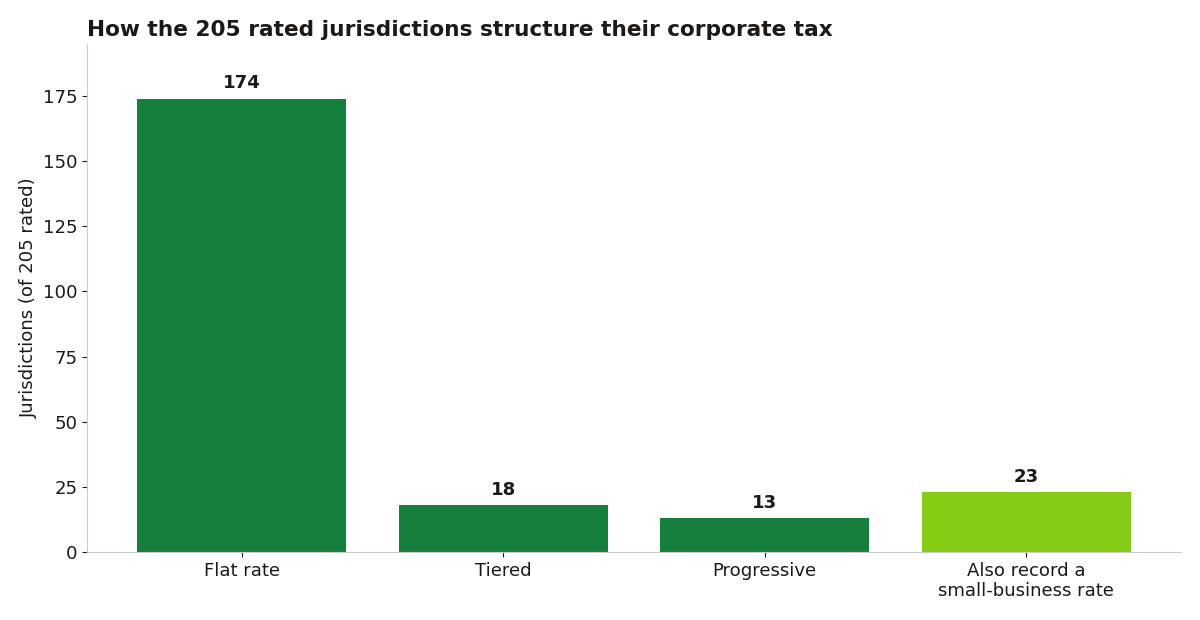
Of the 205 rated jurisdictions, 174 apply a flat rate: one number, no branches. For those, a lookup tool or a chatbot reading good data is genuinely enough. But 18 countries run tiered systems and 13 run progressive scales, and 23 countries record a separate small business rate with its own qualification rules. That is roughly one jurisdiction in five where the headline rate is the beginning of the answer, not the answer.
Where the chatbot answer quietly goes wrong
Sector tiers. Algeria taxes manufacturing at 19%, construction and tourism at 23%, and other activities at 26%. Ask for the Algerian rate and a single number is wrong for two out of three sectors. Thresholds in foreign currencies. Hong Kong charges 8.25% on the first HKD 2 million of profit and 16.5% above it; a chatbot that quotes either figure alone has mispriced your company. Distribution systems. Estonia's 22% and Latvia's 20% apply only when profits are distributed, so describing either as an annual tax on profit, the standard chatbot phrasing, inverts how the system actually works. Stacked taxes. Puerto Rico's 37.5% is an 18.5% normal tax plus a surtax of up to 19% over an income threshold; Germany's roughly 30% is a federal rate plus a municipal trade tax that varies by town. And qualification, the deepest trap: Nigeria now taxes small companies at 0%, but only under turnover and asset ceilings in its 2025 Tax Act. Whether you qualify is a judgment about your books, not a lookup.
A workable rule for when to escalate
Use the tool for the number, use a human for the branch points. If your situation is a single country, a flat rate, and no small business claim, the data is the answer and an expert adds little. The moment your facts include a tier boundary, a sector classification, a small business threshold, a distribution decision, or a second country taxing the same profit, the question has left lookup territory. That is why this site pairs its database with vetted advisor introductions instead of pretending the table settles everything: the ask-an-expert format works when the app knows which questions it should refuse to answer alone.
The contrast, in two countries
Hungary is the chatbot's home turf: a flat 9%, no tiers, no small business overlay in our data, and the answer to almost any Hungarian rate question really is one number. Morocco is the opposite. Its corporate tax is progressive, starting at 20% on taxable profit below MAD 100 million and rising to 35%, with banks and insurers at 40%, so the correct answer depends on the asker's profit and sector, two facts the question usually does not include. A tool that knows which country it is looking at can route accordingly: answer Hungary directly, and turn Morocco into a short interview about profit band and industry before quoting anything. That routing, not the raw lookup, is what separates an expert-grade app from a search box with confidence.
Start with the structured data, then ask better questions
Before any expert call, run your scenario through our TaxStack Calculator. It applies the headline rate, the small business rate where one is recorded, and the rate type from the dataset, which turns a vague worry into a specific question: not what is the tax in Lithuania, but does my company meet the small company conditions for the 0% first two years. Experts bill by the hour; arriving with the branch point already identified is the cheapest preparation there is.
For the raw material behind all of this, see the full corporate tax rates by country table and our field guide to tax advisor marketplace apps vs hiring direct. The chatbot is a fine librarian. Just do not let it sign your tax return.