
January 1 is the day corporate tax tables quietly go stale. Most rate changes are written to take effect with the new tax year, so a table that was right in December can be wrong by New Year, usually in a handful of countries at a time. The corporate tax changes 2027 brings are a good sample: four countries, four different stories, and four different levels of legal certainty. That last part matters. One of these changes is already law. One was announced in a budget and still needs its finance bill. One is a filed bill. One is a cabinet-approved draft racing the calendar. Each section below is labeled with its real status, because planning on a draft as if it were law is how budgets break.
| Country | Recorded today | From January 1, 2027 | Status |
|---|---|---|---|
| Japan | 23.2% national headline; 30.62% combined in Tokyo | 31.52% combined in Tokyo for large corporations | Enacted |
| Malaysia | 24% headline; SME bands at 15% and 17% | SME bands at 14% and 16% from year of assessment 2027 | Budget announced |
| Luxembourg | 23.87% combined in Luxembourg City | 22.80% combined in Luxembourg City | Bill filed, not enacted |
| Poland | 19%, with 9% for small taxpayers | 22% for large companies only | Draft, cabinet approved |
Japan: an enacted surtax that moves the combined rate, not the headline
Status: enacted. Japan's 2025 tax reform adds a special defense surtax of 4 percent on corporate income tax, set out in EY's summary of the reform. It applies to fiscal years beginning on or after April 1, 2026. A company on a calendar tax year feels it for the first time on January 1, 2027, which is why it belongs on this list even though the law is already settled.
The national headline rate does not move: it stays at 23.2 percent, and our dataset keeps recording it that way, with a note that the combined burden in Tokyo runs to about 31.5 percent for large corporations once local taxes stack on. EY puts the Tokyo effective rate at 30.62 percent, rising to 31.52 percent for large corporations once the surtax applies. Same country, same headline, bigger bill. If that gap between the rate on the table and the rate on the invoice is new to you, our statutory versus effective guide walks through why it happens.
Malaysia: SME bands drop a point each, if the Finance Bill passes
Status: budget announced, not yet law. Malaysia's Budget 2027, presented on October 9, 2026, cuts the SME bands from year of assessment 2027: the first RM150,000 of chargeable income at 14 percent, down from 15, and the next band, up to RM600,000, at 16 percent, down from 17. Income above that stays at 24 percent. EY's Budget 2027 snapshots put the maximum saving at about RM6,000 per company, across roughly 300,000 micro, small and medium enterprises.
This is the cleanest before and after of the four, because our dataset records exactly the outgoing bands: 15 percent on the first MYR 150,000 and 17 percent on the next MYR 450,000. Until the Finance Bill passes, those recorded bands are still the law, and the table keeps them. Our small business rates by country guide shows how rare a published SME band is in the first place: only 23 of the 212 jurisdictions in the dataset publish a separate small business rate.
Luxembourg: a filed bill worth a point per band
Status: bill filed, not enacted. Bill No. 8800, filed on October 7, 2026 as part of the 2027 budget package, cuts corporate income tax by one point per band: 14 percent down to 13 on profits up to EUR 200,000, and 16 percent down to 15 above EUR 250,000, as Goodwin's summary of the bill sets out. In Luxembourg City, where the municipal business tax stacks on top, the combined rate would fall from 23.87 percent to 22.80 percent. The same bill abolishes the 17-year limit on carrying losses forward.
Our dataset records Luxembourg at 23.87 percent combined, which matches the bill's starting figure exactly. That number stays in the table until parliament votes the bill through. If it passes as filed, it applies from tax year 2027, and Luxembourg quietly becomes cheaper to run a company through than its headline reputation suggests.
Poland: a 22 percent tier for large companies, still only a draft
Status: draft approved by the Council of Ministers on September 29, 2026, and reported by Bloomberg Tax. The draft raises corporate income tax from 19 percent to 22 percent, but only for companies with prior-year revenue above EUR 50 million, and for tax capital groups. Bank taxation moves on a separate schedule that is already in train: 30 percent in 2026, stepping to 26 percent in 2027 and 23 percent in 2028.
Two honest caveats. First, the draft still has to be adopted, signed and published before January 1, 2027 to apply in 2027 at all: the tightest timeline of the four. Second, for most companies nothing changes. The standard rate stays at 19 percent and the small taxpayer rate stays at 9 percent, so the dataset row for Poland remains correct for standard taxpayers. The 22 percent tier is not in our table, and it will not be until the law actually lands.
What to do with a list like this
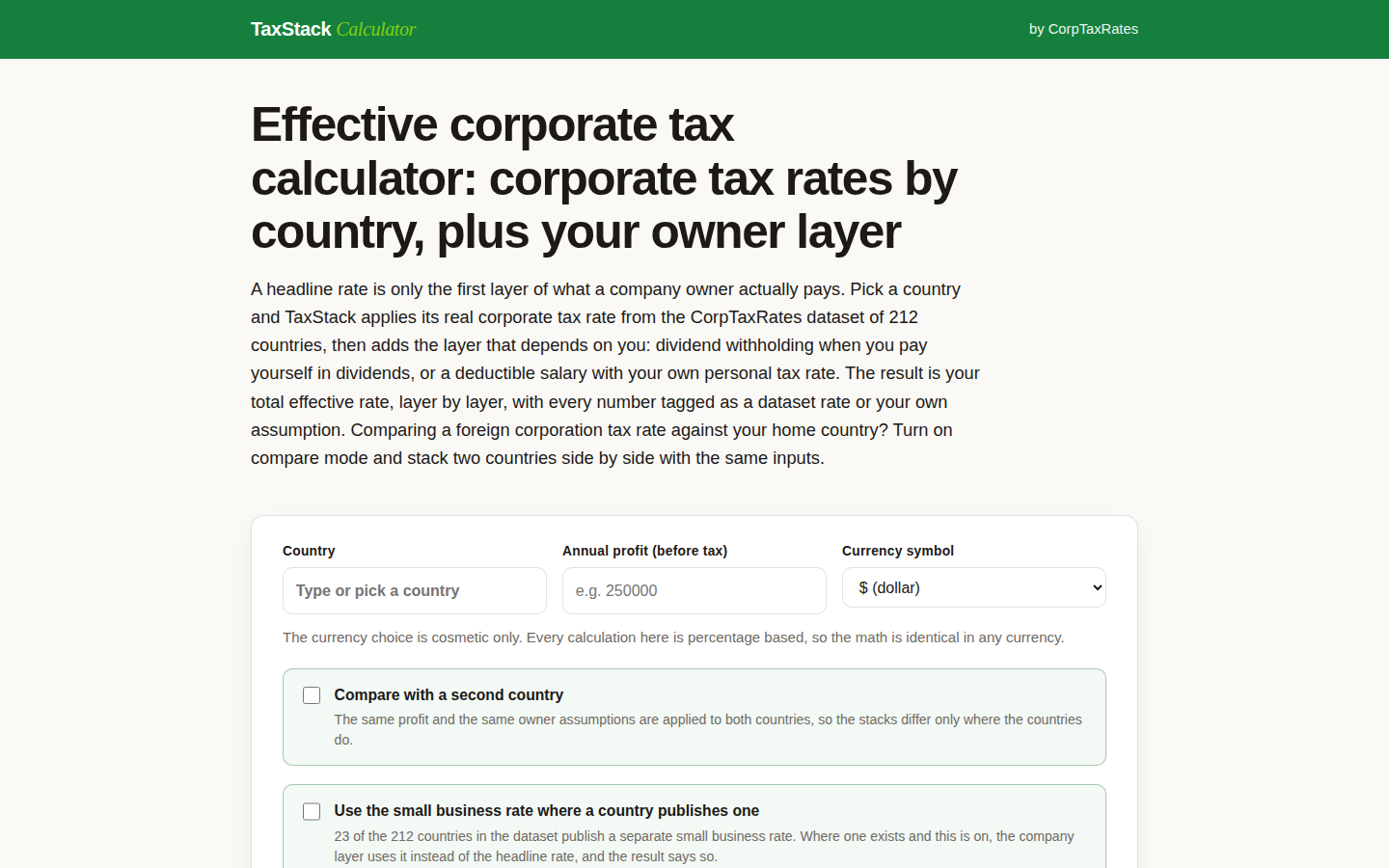
Model the stack that is law today, then re-run it in January. The TaxStack Calculator runs every country at its recorded rate, all 212 jurisdictions, rates verified against official sources on September 14, 2026. It is free, and there is no signup. Run Japan, Malaysia, Luxembourg or Poland now and you get the pre-2027 position, which is the right baseline for a decision you are making this quarter. Our walkthrough of the calculator shows the two-country compare mode, and Ireland vs Germany runs the same profit through two very different stacks if you want to see one worked end to end. Then, once the calendar turns, check which of the four statuses changed and run it again. Our piece on why last year's table lies to you is basically about this exact week of the year.
One boundary worth stating, because the tool states it too: the dataset holds corporate rates only, no withholding or personal tax data. The owner layer in TaxStack is your own entered assumptions, labeled as such, never a recorded rate. And none of this is tax advice. It is a map of what changes and when, drawn from the EY, Goodwin and Bloomberg Tax reporting linked above, checked against a dataset we verify line by line. For the full picture, the 2026 table of corporate tax rates by country is the page to bookmark.