
Most founders meet corporate tax rates at the friendly end of the table, the 9% and 12.5% headlines. This article walks to the other end. Our dataset covers 212 jurisdictions, 205 of them with a headline rate we could verify, and 47 of those charge 30% or more. The median country sits at 25%. The top of the table is a different world, and it is worth seeing exactly who lives there and why.
The top 10, counted from the data
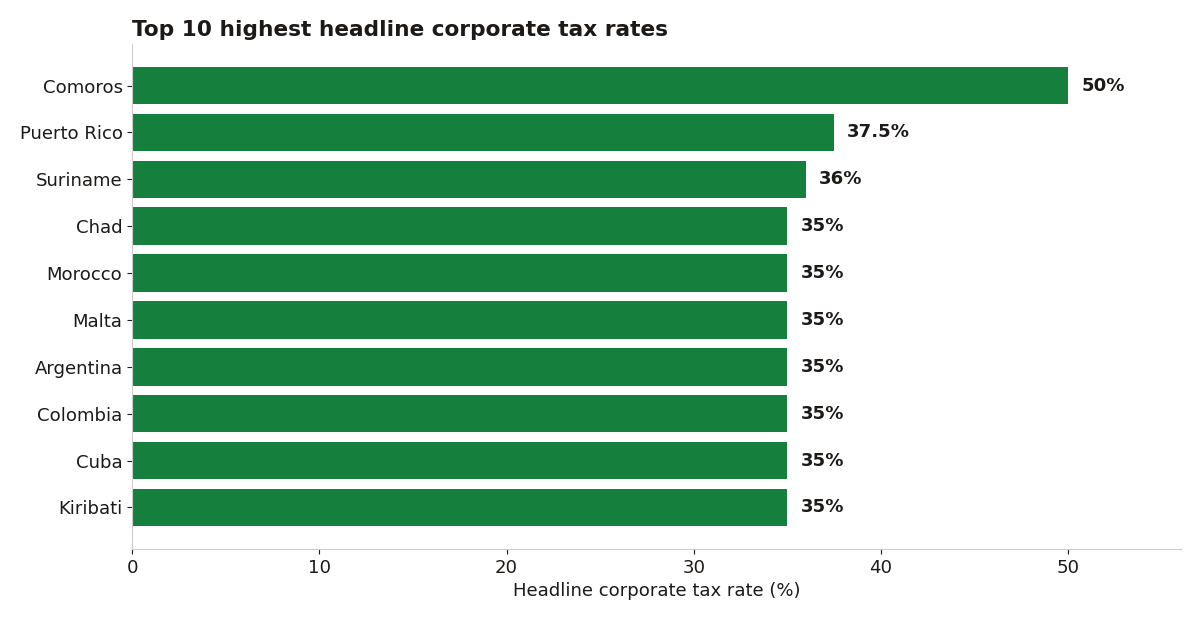
The single highest headline rate in the dataset belongs to Comoros at 50%, with a catch the chart cannot show: the 50% rate is the top of a progressive scale that applies to companies with turnover above KMF 500 million, including state owned companies, while the regular Comoros rate is 35%. Behind it, Puerto Rico charges 37.5%, built from an 18.5% normal tax plus a surtax of up to 19% on income over USD 275,000. Suriname follows at 36%. Then comes a seven-country club at 35%: Chad, Morocco, Malta, Argentina, Colombia, Cuba and Kiribati. Morocco reaches 35% progressively, starting at 20% on taxable profit below MAD 100 million, and its banks and insurers are taxed at 40%.
Why companies stay anyway
A 35% headline rarely means 35 cents of every profit dollar leaves on day one. High-rate countries compete on what sits underneath the rate: deductions, credits, loss rules and sector regimes. The dataset also records how each rate is built, and structure matters as much as size. Germany is the standing example: its 30% typical burden is a stack of a 15.825% federal rate plus a municipal trade tax, not a single national number. Of the 205 rated jurisdictions, 174 use a flat rate, so at the top of the table the sticker price is usually at least the honest starting point. What it never includes is the deduction system behind it, which is why a high-rate country with deep incentives can cost a real company less than a mid-rate country with none.
A reality check just below the cutoff
The top 10 cutoff lands at 34.5%, which is Sint Maarten's flat rate, and Brazil sits one step below at 34%. That detail matters because it shows how crowded the summit is: this is not a freak podium of three outliers but a plateau. Forty-seven of the 205 rated jurisdictions charge 30% or more, so roughly one country in four lives in what founders casually call high-tax territory. The composition of the plateau also varies more than the numbers suggest. Argentina's 35% is the top of a progressive scale, Malta's 35% is flat, and Comoros pairs its 50% top rate with a 35% regular rate. Two countries can share a headline and share almost nothing else, which is why the dataset records the rate type next to every rate and why any ranking that prints the percentage without the structure is only half finished.
One more pattern worth naming: not one of the top 10 records a small business rate in the dataset. The relief valves that soften mid-table countries, Poland's 9% small taxpayer rate, Lithuania's 0% opening years, the UAE's zero band, simply do not appear at the summit. A small company incorporating in a top 10 jurisdiction should assume the headline applies from the first dollar of profit unless a local advisor can point to a regime the data missed, and price that assumption into the decision.
Run your own number before you judge a country
The honest way to compare a 35% country against a 15% one is to push the same profit through both and look at the bill. That is what our TaxStack Calculator does: pick a country, enter annual profit, and it applies the headline rate, the small business rate where one exists, and the rate type, so a flat 35% and a progressive 35% stop looking like the same thing. It takes about a minute, and it is free.
The lesson of the top 10 is not that these countries are unusable. It is that nobody should pay the sticker price unknowingly. If your expansion shortlist includes a 30% plus jurisdiction, read our companion piece on the lowest corporate tax rate countries for the other end of the spread, and our guide to statutory vs effective corporate tax rate before you trust any single number, including ours.