
The lowest nonzero corporate tax rate in our dataset of 212 jurisdictions is 8.5%. Twenty-four jurisdictions sit at 10% or less, and another ten charge nothing at all. That sounds like a short shopping list. It is not, because almost every low headline rate is hiding a second number underneath it, and the second number is usually the one your company would actually pay.
The bottom of the table
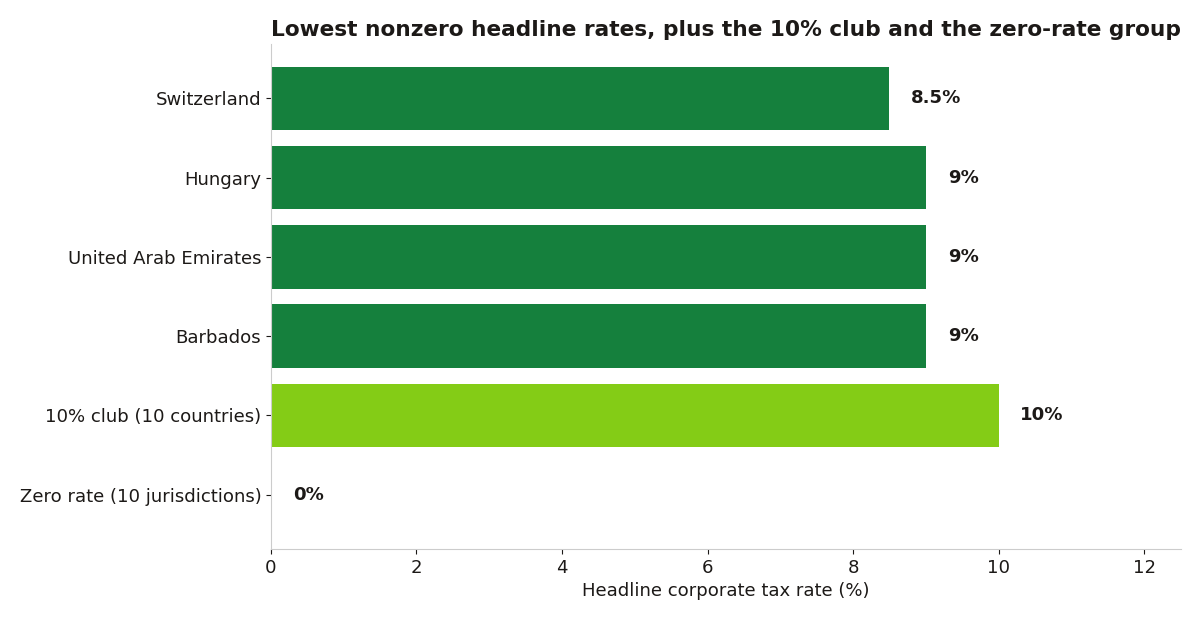
Switzerland holds the lowest nonzero rate at 8.5%, and it is the clearest case of a headline that hides the stack: 8.5% is the federal rate, cantonal and municipal taxes sit on top, and the combined effective burden lands somewhere between roughly 12% and 21% depending on the canton. Next, three jurisdictions share 9%: Hungary, a clean flat 9% with no small print in our data, the United Arab Emirates, where 9% applies only above AED 375,000 of taxable income and the rate below that threshold is 0%, and Barbados, where approved small businesses pay 5.5% while large multinationals face a 15% top-up tax. Ten more jurisdictions charge exactly 10%, including Bulgaria, Qatar, Andorra and Paraguay.
The three things a low headline hides
First, a threshold. The UAE rate is the modern template: the famous 9% is real, but a small company's first AED 375,000 of taxable income is taxed at 0%, so the effective rate on modest profits is far below the headline. Second, a different tax base entirely. Estonia charges 22% and Latvia 20%, which looks mid-table, until you read the base: both tax distributed profits only, so retained and reinvested profit is taxed at 0% as it is earned. A founder comparing Estonia's 22% against Hungary's 9% on headline alone is comparing two different taxes. Third, the zero that is not zero. The ten zero-rate jurisdictions in the dataset are Bermuda, the Cayman Islands, Guernsey, the Isle of Man, Jersey, the British Virgin Islands, Bahrain, the Bahamas, the Marshall Islands and Vanuatu. Zero tax there still means registration fees, economic substance rules, annual filings and banking friction, which is why we wrote a separate honest explainer on what zero really costs.
Barbados shows both directions of the trick inside one country: its 9% headline hides a 5.5% rate that approved small businesses actually pay, and a 15% top-up that large multinationals actually pay. Same island, same statute book, three different real rates depending on who is asking. That is the whole argument of this article in miniature, and it is why the dataset refuses to store any country as a single number.
The 10% club deserves a second look
Sitting one rung above the 9% group is a ten-country club at exactly 10%, and for many founders it is the more practical shortlist. Bulgaria's flat 10% is the lowest simple rate in the European Union, with no tiers or thresholds attached in our data. Qatar charges 10%, Paraguay charges 10%, and North Macedonia and Kosovo keep the Balkan flat-tax tradition alive at 10%. Andorra adds a twist the headline hides in the other direction: its 10% comes with a 2% rate for new companies in their first tax period, recorded in the dataset's small business column. The pattern repeats everywhere at the bottom of the table. The differences that decide real tax bills, thresholds, first-year rates, distribution rules, are all in the second and third columns of the data, never in the headline.
Check the rate you would actually pay
Our TaxStack Calculator was built for exactly this gap between headline and reality. Enter a country and a profit figure and it applies the small business rate where the dataset records one, flags distribution-only systems, and shows the rate type, so the UAE's threshold and Estonia's base stop being footnotes. Run your real expected profit, not a round number: at low profit levels the ranking of these countries changes completely.
None of this makes low-rate countries a trick. Hungary's flat 9% really is simple, and the UAE threshold really does shelter small companies. The point is narrower: a corporate tax rate is a sentence, not a word, and the dataset fields behind each headline, rate type, small business rate and notes, are where the meaning lives. Read the whole sentence before you incorporate on it. For the other end of the spread, see the highest corporate tax rates in the world, and for the zero-rate list in full, countries with zero corporate tax, honestly explained.