
Every corporate tax league table on the internet claims to cover the world. This one is built from a single dataset of world corporate tax rates covering 212 jurisdictions, each rate checked against an official source on September 14, 2026. Here is what the data actually says: where the average really sits, how wide the spread runs, and why the most quoted number in corporate tax, the global average, hides almost everything that matters.
Key findings
- The average headline corporate tax rate across the 205 jurisdictions that publish one is 22.3 percent. The median is 25 percent, so the typical country charges more than the average suggests.
- 10 jurisdictions charge no corporate tax at all, and 43 sit at or below the 15 percent global minimum, including 14 at exactly 15 percent.
- The highest headline rate in the dataset is Comoros at 50 percent. The lowest nonzero rate is Switzerland at 8.5 percent.
- Inside the European Union, rates run from Hungary at 9 percent to Malta at 35 percent, around a median of 22 percent.
- The United States federal rate of 21 percent sits below the world median: 125 jurisdictions charge more, 77 charge less, and only 3 charge the same.
The average is 22.3 percent. The median country charges 25.
Averages in tax tables get dragged down by the zero and single digit jurisdictions at the bottom. The median tells the plainer story: line up all 205 rated jurisdictions and the one in the middle charges 25 percent. The full spread, counted from the dataset:
- Below 15 percent: 29 jurisdictions, 10 of them at zero.
- 15 percent to just under 25 percent: 70 jurisdictions, the biggest single band in the table.
- 25 percent to just under 30 percent: 59 jurisdictions.
- 30 percent or more: 47 jurisdictions, nearly a quarter of the table.
- No published headline rate: 7 jurisdictions in the dataset record none.
Most of the world, in other words, taxes company profits somewhere in the twenties. The famous low rates are real, but they are a minority sport: fewer than one jurisdiction in seven charges under 15 percent.
The highest corporate tax rates in the world
The top of the table is short and steep:
- Comoros: 50 percent, the highest headline rate recorded.
- Puerto Rico: 37.5 percent.
- Suriname: 36 percent.
- At 35 percent: Argentina, Chad, Colombia, Cuba, Kiribati, Malta and Morocco.
- Brazil: 34 percent, and Sint Maarten at 34.5 percent, round out the top of the table.
Our companion piece walks through what those rates mean in practice: Highest Corporate Tax Countries in the World.
The lowest rates, and the countries that charge nothing
At the bottom, 10 jurisdictions record a zero headline rate: Bahrain, the Bahamas, Bermuda, the British Virgin Islands, the Cayman Islands, Guernsey, the Isle of Man, Jersey, the Marshall Islands and Vanuatu. Above them, Switzerland records 8.5 percent, then Barbados, Hungary and the United Arab Emirates at 9 percent, and a group of 10 jurisdictions at 10 percent that includes Bulgaria and Qatar. The zero list comes with its own costs and conditions, covered honestly in Countries With Zero Corporate Tax and Lowest Corporate Tax Countries.
What changed coming into 2026
Rates move every year, and the 2026 column of the dataset records several shifts worth knowing. Cyprus raised its headline rate from 12.5 percent to 15 percent on January 1, 2026, ending its run as one of Europe's cheapest addresses. Lithuania raised its standard rate from 16 to 17 percent. Estonia continues to tax only distributed profits, at 22 percent, leaving retained earnings untaxed. Morocco's top rate now records 35 percent. The changes already scheduled for next year are tracked in Corporate Tax Changes on January 1, 2027.
The 15 percent floor under the bottom of the table
The global minimum tax agreed through the OECD is quietly repricing the bottom of this table. Forty three jurisdictions in the dataset sit at or below 15 percent, and for the largest multinational groups, those in scope of the rules, top-up taxes pull the effective rate toward 15 percent regardless of the headline. The dataset records the mechanism at work in its own notes: the United Arab Emirates pairs its 9 percent headline with a 15 percent minimum top-up for the largest groups, and Ireland records 15 percent for in-scope multinationals against its 12.5 percent headline. For everyone below that scale, the headline rate is still the rate that decides the bill.
Europe in one view
The European Union's 27 member states average about 21 percent, with a median of 22 percent. The bottom of the EU table is Hungary at 9 percent and Bulgaria at 10 percent, then Ireland at 12.5 percent and Cyprus at its new 15 percent. The top is Malta at 35 percent and Germany at a typical combined 30 percent, with the Netherlands at 25.8 percent. The full regional picture is in Corporate Income Tax Rates in Europe.
Run your own stack
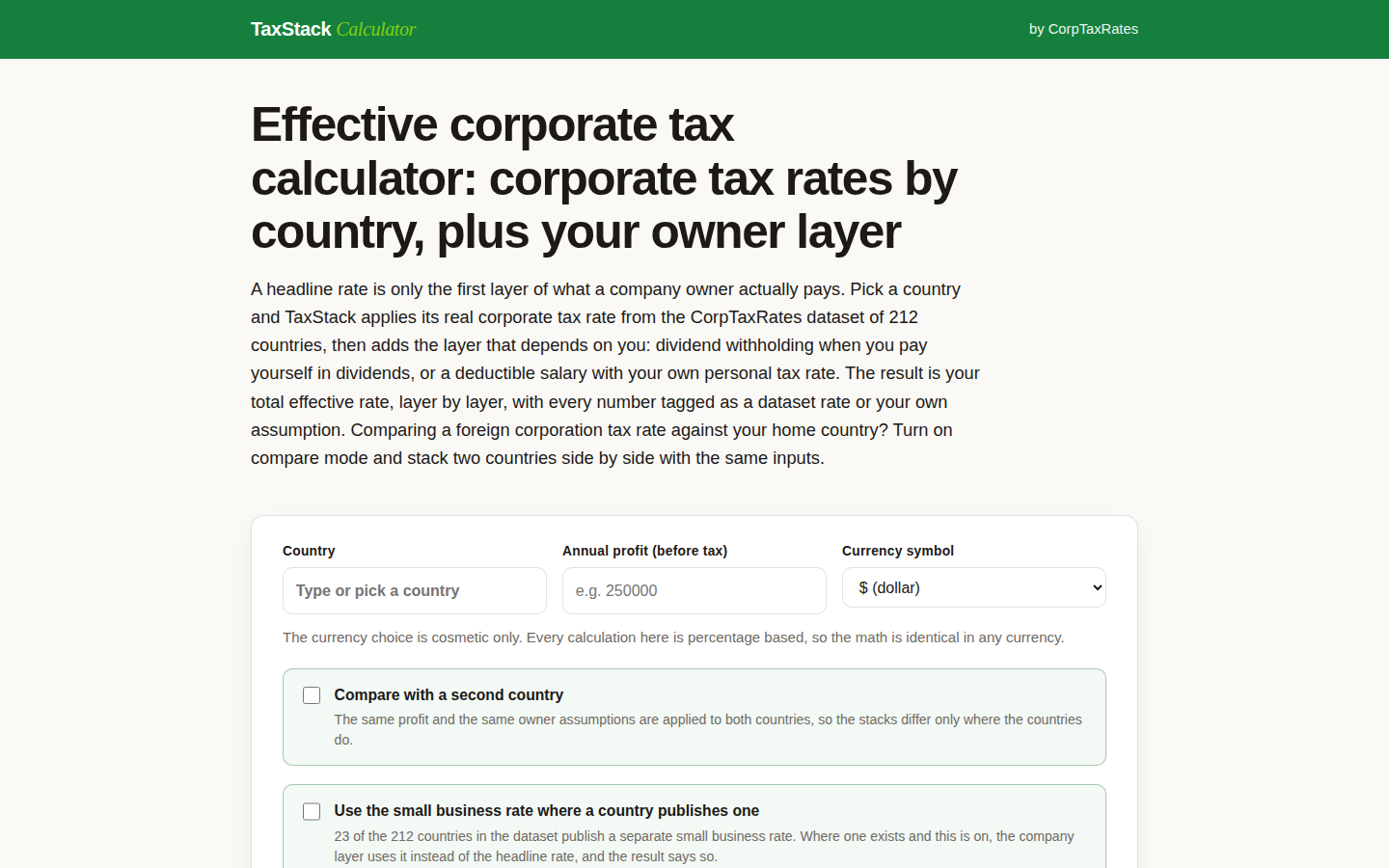
A headline rate is only the first layer of what a company actually pays. The second layer is what happens when the owner takes money out, and it changes the ranking more often than the first layer does. The TaxStack Calculator runs both layers for any of the 212 jurisdictions in this dataset: pick a country, enter a profit, choose how you pay yourself, and see the total effective rate. The full country table lives in Corporate Tax Rates by Country, and if you want a human to look at your shortlist, get an intro.